What Killed The Swimming Pigs?
The 2017 deaths at Big Major Cay, what investigations pointed to, and how swimming pig tours in Exuma operate differently today.
Several pigs at Big Major Cay, the original Pig Beach in the Exuma Cays, died in 2017, and reporting at the time linked the deaths to sand ingestion: pigs fed unsuitable food, or fed on the sand, swallowed sand along with it, and the accumulated sand was found in the animals during examination. The deaths prompted operators to tighten feeding rules that crews still follow on tours today.
The swimming pigs of Exuma are the island chain's most famous residents, and the Bahamas Ministry of Tourism describes about 20 pigs and piglets living on the uninhabited cay, reachable only by boat. For years before 2017, the colony grew alongside a rising tide of visitors, and the animals learned that approaching people in the water meant food. That learned behaviour, combined with visitors handing over whatever they had on board, is the background to what happened.
The colony survived. Pig Beach today is still the anchor stop of nearly every full-day boat trip out of Nassau and the Exumas, and pigs still swim out to meet approaching boats. But the 2017 deaths are the reason crews, not passengers, now control every piece of food that reaches the water. If you have read a headlines-only version of the story, the practical detail worth knowing is this: the changes that followed were about how the pigs are fed, not whether people can visit them.
What Exactly Happened At Big Major Cay In 2017?
In early 2017, a number of pigs at Big Major Cay were found dead over a short period, with reporting at the time linking the deaths to sand ingestion by the animals, a problem the feeding rules now in place are designed to prevent. The sand had accumulated as the pigs ingested it along with food, and the finding became the accepted explanation for the deaths.
The detail matters because it rules out some of the rumours that circulated afterwards. The deaths were not a poisoning, an attack, or a disease outbreak in the way early speculation suggested. The animals were eating sand because food was being offered in ways that put grain and sand together: tossed onto the beach, left on the shore, or handed over in the shallows where pigs rooting for it swallowed sand with every mouthful.
Pigs root. It is what they do, and on a cay whose shoreline is sand and crushed coral, any feeding pattern that puts food on the ground puts sand in the pig. Add visitors arriving daily with bread, chips, and beer in coolers, and the pattern that emerged was one nobody had designed and nobody was monitoring. A full account of the episode and the questions it raised about animal welfare sits in our longer piece, are the pigs treated well.
What followed was not a government crackdown. No official feeding regulation for Big Major Cay appears on any Bahamas government page, and the Ministry of Tourism's own description of the pigs states no feeding rules at all. What changed instead was operator behaviour, and it changed fast, because a dead colony is a dead business.
How Did Sand Kill A Pig?
Sand is indigestible. When a pig swallows sand with its food over weeks and months, the material builds up in the digestive tract, and the accumulated load can block or damage the gut. The examinations carried out after the 2017 deaths found this sand load inside the dead animals, which is why the incident is described as a sand ingestion event rather than a poisoning or disease.
A pig that feeds in clean water, taking food from a hand or from the surface, swallows almost nothing but the food. A pig that feeds on a beach, or that roots in the shallows for food that has sunk or been dropped, swallows whatever the food is mixed with. On Big Major Cay, that substrate is sand and fine coral rubble. The volume adds up, and pigs cannot pass it the way they pass fibre.
The second factor is food quality. Visitors historically fed the pigs bread, processed snacks, and in some reported cases alcohol, none of which suits a feral pig's digestion. Poor food weakens the animal, and a weakened animal grazing a sand substrate ingests more, not less. The combination is what the 2017 examinations pointed to: malnourished animals carrying heavy sand loads.
The fix, once the cause was understood, was straightforward, and it is the fix still in place: food that pigs can digest, delivered in water where sand cannot mix with it, in quantities the crew controls. No part of that requires a law. It requires a captain who says, at the start of every stop, that the crew feeds the pigs and guests do not.
What Rules Do Pig Beach Tours Follow Now?
Operators ask guests to let the crew handle all feeding: food is captain-provided only, given in the water or by hand, never on the sand, and never from a passenger's own supply. Guests are asked not to chase, corner, or pick up piglets, to keep distance from mothers, and to take all rubbish back to the boat. These are operator-set rules, not published law.
It is worth being precise about the status of these rules, because plenty of articles state them as regulations. No government feeding regulation for the pigs was found on the official Bahamas tourism or Bahamas National Trust pages, and no official landing-permit requirement for Big Major Cay could be confirmed either. The feeding and behaviour rules come from the operators themselves, briefed on the boat, and the strongest incentive to enforce them is that these companies watched what happened in 2017.
In practice the briefing is short and consistent across the main tour operators. The approved foods are things like fruit, vegetables, and proper pig feed. Feeding happens in the water or from an open hand, so the pig takes food cleanly rather than rooting for it. Food never goes on the sand, and it never comes from a passenger's cooler. Guests swim, watch, and photograph; the crew feeds.
The National Trust's rules for the wider Exuma Cays Land and Sea Park, published on its park page, take a stricter line on wildlife generally, and Pig Beach lies outside the park's southern boundary, per operator-sourced reporting. But the spirit is the same everywhere in the cays: the animals set the terms, and the people on the boat adapt to them.
Can You Still Swim With The Pigs After 2017?
Yes. The colony at Big Major Cay survived the 2017 deaths and pigs still swim out to approaching boats, with about 20 pigs and piglets described on the official tourism page. Visits continue on guided boat tours from both Nassau and the Exumas, typically as a stop of roughly 20 to 60 minutes within a longer island-hopping day. The longer answer, including how the rules shape a visit, is in can you still swim with the pigs in the Bahamas.
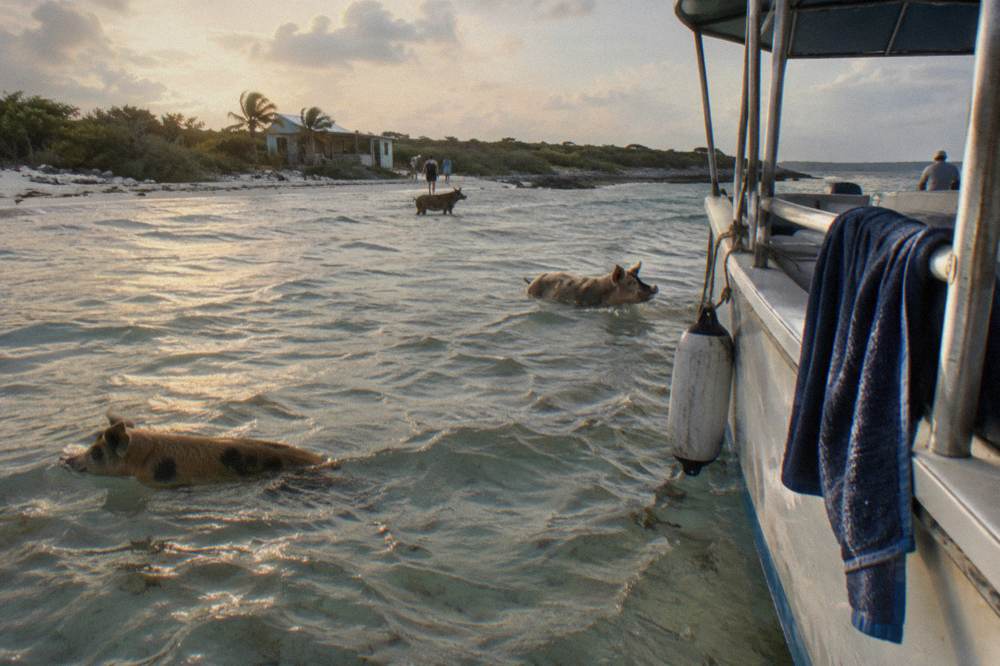
The experience today is built around the feeding rules, and honestly, it is better for them. Instead of a chaotic scrum of passengers hurling bread, a well-run stop looks like this: the boat anchors off the beach, the pigs swim out, the crew distributes food in the shallows, and guests are in the water alongside the animals while the feeding happens under crew control. The pigs approach because they choose to, which is the entire basis of the attraction. The full index of guides sits on Exuma Tours.
The stop is short by design. Operators typically budget 20 to 60 minutes at Pig Beach depending on crowds and conditions, because the rest of the day belongs to the other stops: the iguanas of the northern cays, the nurse sharks at Compass Cay, Thunderball Grotto, and the sandbars. Day trips from Nassau typically pair Pig Beach with other Exuma Cays stops; it is roughly two to three hours of open water each way, so the pigs sit inside a full-day itinerary.
One habit worth naming: the pigs will investigate anything floating. Sunglasses, hats, and unattended snacks have all been lost to curious pigs, and operators advise keeping a grip on your things while in the water. The animals are wild, healthy, and completely unbothered by people, which is exactly why the rules exist to keep them that way.
The most-reviewed Nassau departure on this route is the Exuma Island Hopping Swimming Pigs Tour with Lunch, rated 4.8 across 689 reviews, from $438.90 per person for a day of roughly 8 hours. Food handling on stops like this sits with the crew, consistent with the rules that followed the 2017 deaths, and specifics of what a given departure includes are on the booking page.
How Do You Pick A Tour That Treats The Pigs Well?
Look for three things: a crew-run feeding policy stated in the tour description, a full-day itinerary that spreads time across several stops rather than parking at Pig Beach, and an operator whose description mentions landing fees or wildlife stops being included, which signals a licensed, established operator rather than an informal boat. Price is a weak signal here, but rock-bottom pricing on a long run to the cays is worth a second look.
The tours that run this route well tend to look similar on paper, and that similarity is a good sign. A responsible day trip from Nassau includes the boat, the crew, lunch, and the stops, with landing fees absorbed into the price. Operators normally absorb the small per-person landing fees charged around the cays, such as the Compass Cay day-use fee of $15 per person reported at the marina there, and a tour that itemises none of this is worth a question before you book.
| Tour | Length | Rating | From (per person) |
|---|---|---|---|
| Exuma Island Hopping Swimming Pigs Tour with Lunch from Nassau | ~8 hours | 4.8 across 689 reviews | $438.90 |
| Exuma Powerboat Tour from Nassau with Swimming Pigs | ~8 hours | 4.8 across 536 reviews | $439 |
| Exuma Day Away, Original Swimming Pigs Excursion | ~8 hours 30 minutes | 4.5 across 474 reviews | $378 |
| Original Exuma Powerboat Adventures | ~9 hours | 4.7 across 553 reviews | $328.90 |
For readers weighing the experience against its cost, the full price picture, including shorter and cheaper options from Great Exuma, is laid out in how much does swimming with pigs cost.
Ask the operator, or check the booking page, about two specifics: who feeds the pigs, and whether the itinerary includes the other wildlife stops. A tour that only sells the pigs will spend too long at one beach, and too long at one beach is precisely the pressure that fed the old, uncontrolled feeding patterns. The better trips move, and the moving keeps the encounter brief and clean.
What Does A Responsible Pig Beach Day Look Like?
A responsible day runs long, roughly 8 to 9 hours from Nassau, with the pigs as one stop of five or six. The crew briefs the feeding rules on the way out, food stays with the crew, guests swim and photograph, and the boat moves on to iguanas, nurse sharks, and a sandbar, with lunch served on board or at a cay marina.
From Nassau, that day starts early, with check-in around 8:45 AM at the Paradise Island ferry terminal area for departures near 9 AM on the established powerboat runs, and a return in the late afternoon. The crossing is two to three hours each way over open water, so the day is a commitment, and some listings note it may not suit cruise ship passengers on tight schedules. Within that framework, though, the rhythm of the day protects the animals: nobody lingers long enough at any one cay for the old patterns to reassert themselves.
From Great Exuma, the geography is different, and so is the product. Trips out of Barraterre Dock on Great Exuma can reach the same famous sites on a similar full-day schedule, and shorter options from Great Exuma often visit closer pig cays such as White Bay Cay rather than running the full distance to Big Major. Both are legitimate, but they are different animals, quite literally: the original colony is the one at Big Major Cay, and if that specific beach is what you came for, confirm which cay the itinerary includes on the booking page.
What to bring is the same on either route: reef-safe sunscreen, a hat, a towel, a waterproof pouch, and water shoes, per the packing lists local operators publish. Season matters too: hurricane season runs 1 June to 30 November with its peak August to October, and rough-sea cancellations cluster in that window, while December to May typically brings calmer conditions and clearer water. More detail on both is in our Exuma boat tours compared guide.
There is also the question of what your presence does. The honest answer is that a well-run tour, feeding the pigs operator-provided food in the water, is a system that has kept the colony alive and visible for nearly a decade since the deaths. A poorly run one, or a self-guided landing, reintroduces exactly the behaviour that killed seven of them. Choosing the operator is the single biggest welfare decision a visitor makes, and it takes about ten minutes of reading a booking page.
Why The Story Matters More Than The Rumours
The 2017 deaths are remembered as a mystery, but the examinations pointed to a mundane, preventable cause: sand swallowed with unsuitable food. No poisoning, no crime, no ban followed. What followed was a set of crew-enforced feeding rules that have governed every responsible visit since, and the pigs at Big Major Cay are still there, still swimming, still the reason most people make the trip.
The rumours persist because the true story is unglamorous. It is easier to remember a poisoning than a gut full of sand, and easier to demand a law than to accept that the fix lives in a captain's morning briefing. The verified record is narrower than the internet's version: animals died, sand was found, operators changed the feeding, and no official regulation was ever published on any government page that this site could verify.
That gap is why the operator you choose carries the weight it does. The Ministry of Tourism's page on the pigs describes the colony and the experience but sets out no feeding rules; the enforcement layer is the crew on your boat. When a tour description says the crew handles the feeding, that line is not fine print, it is the entire safeguard system in five words.
For anyone planning the trip itself, the practical next step is simple: pick a tour whose description puts the feeding with the crew, check the itinerary covers the cays you care about, and let the animals come to you. That is the whole lesson of 2017, and it fits in a waterproof pouch alongside your sunscreen.
Common Questions About The Swimming Pigs
What Killed The Swimming Pigs?
Several pigs at Big Major Cay died in 2017, and veterinary examinations found large amounts of sand in the animals, linking the deaths to sand ingested along with food that was being fed on or near the beach. The cause was preventable, and operator feeding rules introduced afterwards are designed to stop it recurring.
Are The Swimming Pigs Still Alive?
Yes. The colony at Big Major Cay survived, and the official Bahamas tourism page describes about 20 pigs and piglets on the cay. Pigs still swim out to approaching tour boats, and visits continue from both Nassau and the Exumas under crew-run feeding rules.
Is It Illegal To Feed The Pigs Yourself?
No official government feeding regulation for the pigs was found on Bahamas tourism or National Trust pages, so it is not accurate to call it illegal. It is against the rules every responsible operator sets: crews ask guests to let them handle all feeding, with captain-provided food, in the water, never on the sand.
Why Can't You Feed The Pigs On The Sand?
Because pigs root for food. When food lands on sand, the pig swallows sand with it, and over time the sand accumulates in the digestive tract. That accumulation is what the examinations found in the animals that died in 2017.
Did Tourists Kill The Swimming Pigs?
The deaths followed years of uncontrolled feeding by visitors, including unsuitable food and food left on the shoreline, so visitor behaviour was the root cause. But no single person or group was blamed, and the response focused on changing how tours manage feeding rather than restricting access to the cay.
Do Tours Still Let You Get In The Water With The Pigs?
Yes. Guests swim alongside the animals at Pig Beach on essentially every tour. What changed after 2017 is who feeds them: the crew controls the food, in the water, while guests swim, watch, and photograph. A typical stop runs about 20 to 60 minutes within a full-day itinerary.